

 UK
UK
 AU
AU
 US
US

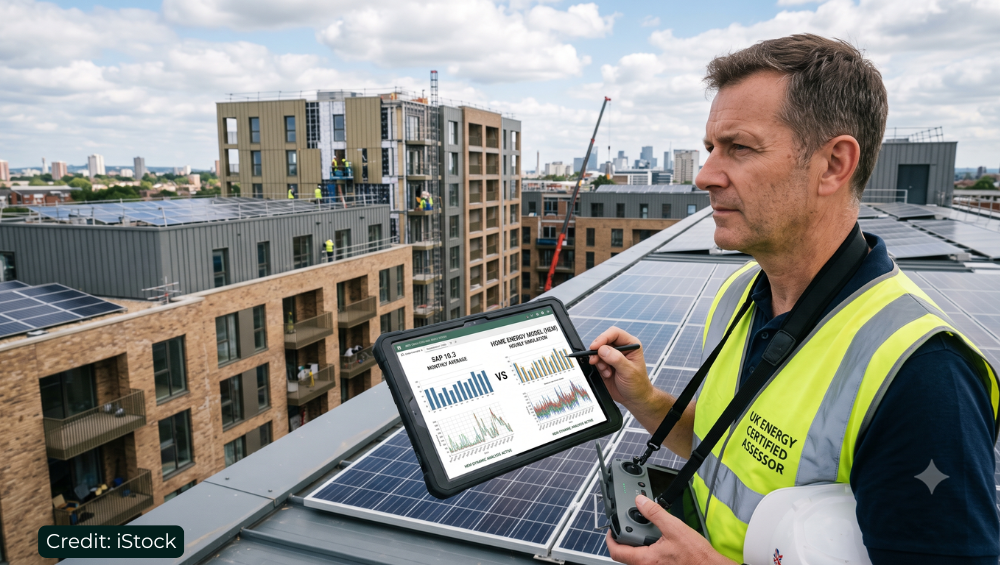
The regulatory framework for UK housebuilding is undergoing its most significant overhaul in a generation. The government has published the final Future Homes Standard (FHS) Approved Documents, confirming that the new regulations will formally take effect on 24 March 2027.
For property developers and social housing providers, a major change will be solar becoming mandatory on new homes and the retirement of the long-standing Standard Assessment Procedure (SAP).
First introduced in 1993, SAP has served as the UK’s benchmark for energy efficiency methodology. However, its monthly average calculations are fundamentally outdated for a modern, grid-interactive world. In its place comes the Home Energy Model (HEM), the next generation of energy compliance designed as a cloud-based, physics-based simulation engine to ensure new homes are truly net-zero ready.
As the industry untangles the changes, a question mark hangs over multi-family developments: Will flats get left behind? Between strict new renewable mandates, rising capital expenditure (cap-ex) and a complex software transition, developers building blocks of flats face complex compliance issues.
In the short-term, the government has announced a revised, three-phase rollout to ensure industry stability:
- Phase 1: SAP 10.3 Solo (Minimum 3 Months): Currently, an updated version of the old system (SAP 10.3) serves as the sole available compliance tool. It applies the strict new notional building targets of the FHS while maintaining the familiar monthly calculation method.
- Phase 2: Dual Compliance (24 Months): On the 24th of March 2027, once the HEM cloud infrastructure is fully approved, both SAP 10.3 and HEM will be accepted. The industry can, therefore, transition to high-resolution modelling without halting active projects.
- Phase 3: HEM Only: Then, 24 months after the dual compliance framework, HEM will become the exclusive regulatory tool for all new residential buildings and the generation of Energy Performance Certificates (EPCs).
|
Feature |
Classic SAP (Up to 10.3) |
Home Energy Model (HEM) |
|
Calculation time step |
Monthly averages (12 data periods per year) |
Half-hourly simulations (17,520 timesteps per year) |
|
Core architecture |
Rigid desktop database; slow to adopt new technologies |
Cloud-based, with a modular open-source framework |
|
Solar PV |
Annual energy yield estimate |
Half-hourly generation and self-consumption modelling |
|
Battery storage |
Limited or simplified representation |
Models battery charge/discharge cycles and interaction with solar generation |
|
Smart technologies |
Limited recognition of smart controls and demand flexibility |
Designed to model smart controls, EV charging, flexible tariffs and demand response |
|
|
Fixed annual electricity carbon factor |
Uses forward-looking electricity carbon factors and dynamic energy modelling |
|
Technology updates |
Methodology updated periodically through new SAP versions |
Modular framework intended to be easier to update as technologies evolve |
Under the Future Homes Standard, all new-build homes will be required to feature renewable energy, with rooftop solar PV acting as the primary solution. For a standalone house, meeting these requirements is straightforward, however, for a block of flats, it can be an architectural and financial headache.
If classic methods to install solar are used, developers must assign a dedicated piece of the roof to an individual flat, installing separate panels, individual inverters, isolated wiring and independent utility meters for every single dwelling. This traditional approach presents three massive hurdles:
- Significant investment: Multiplying hardware, installation labour and individual grid connection fees across flats creates exceptionally high costs that can hit margins hard.
- Roof space insolvency: High-density blocks have a massive ratio of residents relative to a strictly limited roof footprint. Multi-storey developments simply lack the roof area to give every apartment its own compliant, viable solar array.
- The EPC loophole closure: Under the incoming HEM system, flats will only earn an Energy Performance Certificate (EPC) uplift if the rooftop solar is wired directly to their individual meters. This effectively closes previous loopholes where communal arrays only powered the landlord’s switchboard or common areas, forcing developers to find a way to deliver solar directly to the tenants.
To avoid leaving flats behind, developers need an innovative setup that satisfies the rigorous demands of the Future Homes Standard without skyrocketing construction costs. This is the foundational concept behind Allume's shared solar technology, SolShare.
Rather than forcing single-home logic onto apartment blocks, SolShare connects multiple apartments to a single, shared rooftop PV array and batteries. This centralised approach offers several core advantages for developers:
- Granular system sizing: A standard SAP assessment will allocate PV to each flat based on 400W increments. SolShare can allocate the total kWp system size to flats based on a 10W basis, allowing for significantly greater tailorability and potentially reducing the overall array size by 15-20%.
- Dynamic energy delivery: Rather than blindly delivering power, SolShare monitors the live demand of each flat. If one flat is using less power than their allocation, the system identifies demand in another flat and directs the excess solar there, maximising resident savings.
- Preserved roof integrity: By utilising a shared array, the system requires fewer DC cable roof penetrations, preserving the watertight integrity of the roof and vastly simplifying the roofing contractor's warranty.
- Centralised safety & maintenance: With built-in internet monitoring and a single point of automated AC isolation, the system simplifies fire safety compliance and creates clear maintenance responsibilities for the managing company.
| HEM capability | How SolShare helps |
|---|---|
| Half-hourly energy modelling | SolShare distributes solar electricity to flats in real time, allowing HEM to better capture actual self-consumption patterns. |
| Solar self-consumption | Increases the proportion of rooftop solar used within the building instead of being exported to the grid. |
| Battery integration | SolShare 2 integrates with communal battery systems, allowing HEM to model battery charging, discharging and increased solar utilisation. |
| Smart energy management | Dynamically allocates solar electricity to where demand exists, improving energy efficiency across multiple dwellings. |
| Reduced grid imports | By matching solar generation with household demand, SolShare can reduce reliance on imported electricity throughout the day. |
| Future-ready technology | Designed to work alongside smart controls and flexible energy systems that HEM is intended to recognise. |
As the industry moves from the familiar territory of SAP 10.3 into the dynamic, high-resolution HEM era, there is a clear incentive on buildings to perform efficiently both on paper and in the real world.
For developers and social housing providers, trying to force single-home solar logic onto flats can be an expensive recipe for disaster. Shifting to shared infrastructure like SolShare is the ultimate way to fix this. Through this approach, the transition to HEM can be transformed from a compliance hurdle into an opportunity to keep capital expenditures under control and protect flat residents from volatile energy costs.
Ready to simplify your FHS compliance and optimise your upcoming projects? Connect with the Allume UK team today to discover how SolShare fits into your development pipeline.