

 UK
UK
 AU
AU
 US
US

The UK's energy resilience challenge: why clean energy must work for everyone
The question of national energy resilience has dominated political and economic headlines across the UK.
For years, the UK has been vulnerable to severe energy price shocks, exposed by a heavy reliance on volatile international fossil fuel markets, unpredictable geopolitical instability and an aging, centralised grid infrastructure. This means that when global wholesale gas and electricity markets fluctuate, the shockwaves are felt on the doorsteps of millions of households.
The economic toll can be staggering. With Ofgem's price cap rising in July by 13.5%, typical annual fuel bills have skyrocketed to levels roughly 79% higher than they were before winter 2020/21. Over 13 million households have been pushed into fuel poverty.
It is estimated that domestic consumers owe energy suppliers a combined debt of over £4 billion..
To break this cycle of vulnerability and to deliver energy security, the UK must overhaul how we heat and power our homes. A key solution lies in localised renewable energy infrastructure, specifically the rapid, mass deployment of rooftop solar combined with advanced battery integration.
Generating power at the point of consumption removes reliance on international supply chains and takes the strain off the grid. However, if this transition is to deliver true resilience across the country, clean energy cannot remain an exclusive luxury for single-family, suburban homes. It must reach everyone.
While the solution to energy resilience is clear, the distribution of its benefits has been deeply unequal. There is a real "solar disparity" in the UK housing stock: approximately 7% of traditional standalone houses and bungalows feature solar panels, compared with just 3% of multi-unit flats. In dense urban centres, that figure plummets to below 1%.
This is the direct result of architectural and technical constraints when it comes to installing solar on apartments. The approach to solar was traditionally built to accommodate single-meter, single-family homes. When applied to multi-story apartment blocks or social housing, installs become challenging. Previously, if a landlord or developer wanted to provide clean power to residents, they had to slice the rooftop into isolated, individual segments. Each flat must then have been equipped with its own dedicated panels, a separate inverter, complex independent wiring and an individual utility meter.
How shared solar is unlocking clean energy for apartment buildings
Allume’s SolShare technology was engineered specifically to break this multi-family barrier.
Allume has launched SolShare 2, marking the next generation of shared solar technology and battery control for apartment buildings.
SolShare 2 introduces a 50% increase in energy-sharing capacity, increasing the supported inverter size from 20kW to 30kW while continuing to serve up to 15 connections per unit. This provides greater flexibility to design larger rooftop solar systems, maximising SAP and EPC performance while allowing more solar generation to be allocated where individual flats need it most.
SolShare 2 also introduces advanced communal battery integration. SolShare 2 can now support DC-coupled battery storage across virtually any suitable installation, enabling landlords and developers to locate battery systems safely within dedicated plant rooms or external enclosures rather than inside individual apartments. This simplifies compliance, supports safer battery deployment and allows surplus solar energy to be stored for use during the evening, helping maximise self-consumption and enabling residents to reduce electricity bills by up to 70%.
SolShare allows an entire building to be powered by a shared commercial solar array with one inverter per SolShare unit. The SolShare hardware sits entirely behind the meter, acting as an intelligent distribution hub between the shared solar array and each apartment's existing electricity meter.
Through this setup, SolShare dynamically routes the generated clean electricity directly to individual consumer units in real time, instantly matching solar generation with whichever flats are actively drawing power at that moment. This intelligent load-sharing delivers three key benefits:
- It maximises self-consumption: By intelligently sharing solar between residents, virtually every watt of renewable energy generated on the roof is used within the building whenever possible.
- It minimises grid exports: Rather than exporting unused electricity back to the grid, surplus generation is shared between residents or stored in communal batteries, reducing strain on the wider electricity network.
- It cuts resident electricity bills: Delivering solar energy directly behind the meter enables residents to significantly reduce their reliance on grid electricity, with suitable projects achieving bill savings of up to 70%.
Crucially, the system is designed with flexibility in mind. SolShare can be deployed as both a retrofit solution for existing apartment buildings and social housing, or integrated into new-build developments to help meet increasingly stringent energy performance requirements.
Scott Court: a blueprint for a more resilient and inclusive energy future
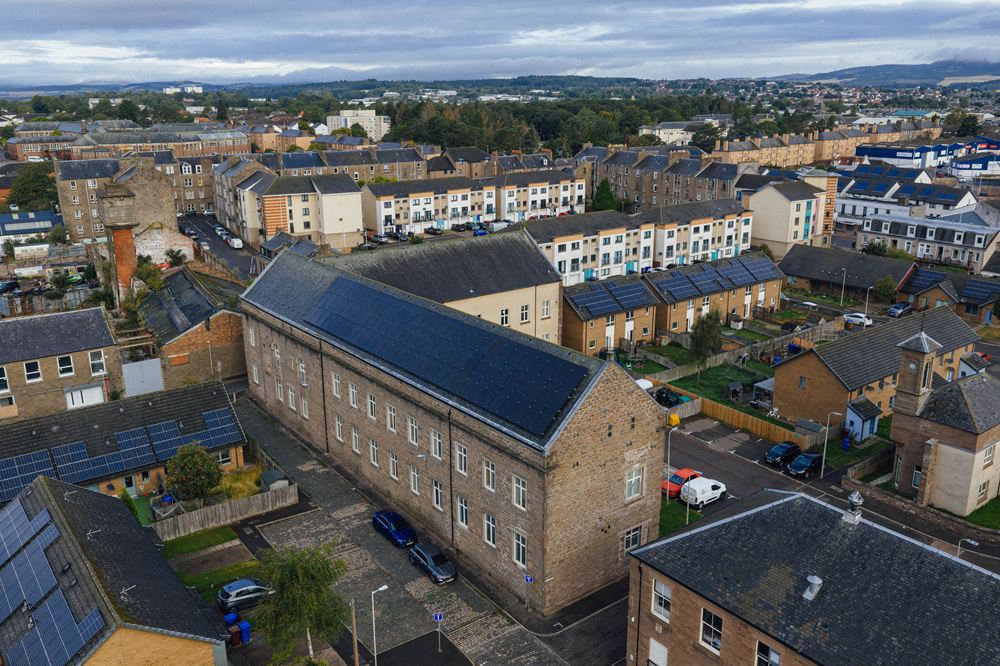
We don’t have to look far to see how this infrastructure successfully shifts communities from vulnerability to long-term resilience. In Dundee, Scotland, Allume Energy partnered with housing association Hillcrest Homes to deliver a pioneering solar retrofit at Scott Court.
Scott Court presented significant structural and regulatory compliance challenges. As a historic listed residential building with tightly restricted roof space, conventional flat-by-flat solar configurations were not a viable option.
Instead, the project deployed a single, centralised rooftop solar array connected entirely through SolShare technology, enabling the available roof space to be shared efficiently across multiple apartments. By utilising ECO4 funding, the project was delivered at zero cost to the housing association.
The intervention successfully brought modern, high-performance energy efficiency to a historic asset without disrupting the architectural integrity of the building or requiring invasive internal equipment installations for tenants. It successfully lifted individual Energy Performance Certificate (EPC) bands across the development, future-proofing the asset portfolio.
More importantly, the real-world outcome has provided crucial financial stability to the residents underneath that roof. David Conway, Head of Asset Management at Hillcrest, captured the tangible human impact of the project:
"Many of our tenants at Scott Court have already reported noticeable savings on their energy costs, with some saying they're topping up their pre-payment meters far less frequently. This is a real and tangible step forward in our mission to tackle fuel poverty."
The regional success of Scott Court has been recognised on a national stage. We are incredibly proud to share that the project was officially named the Retrofit Project of the Year (Scotland and the North) at the Unlock Net Zero Awards 2026.
The Unlock Net Zero Awards celebrate the best of the housing sector. Winning this award sends a message to both policymakers and developers: true national energy resilience cannot be achieved through aggregate macro-green targets alone. It is won on the ground by delivering socially responsible solutions that protect our most vulnerable communities from fuel poverty.
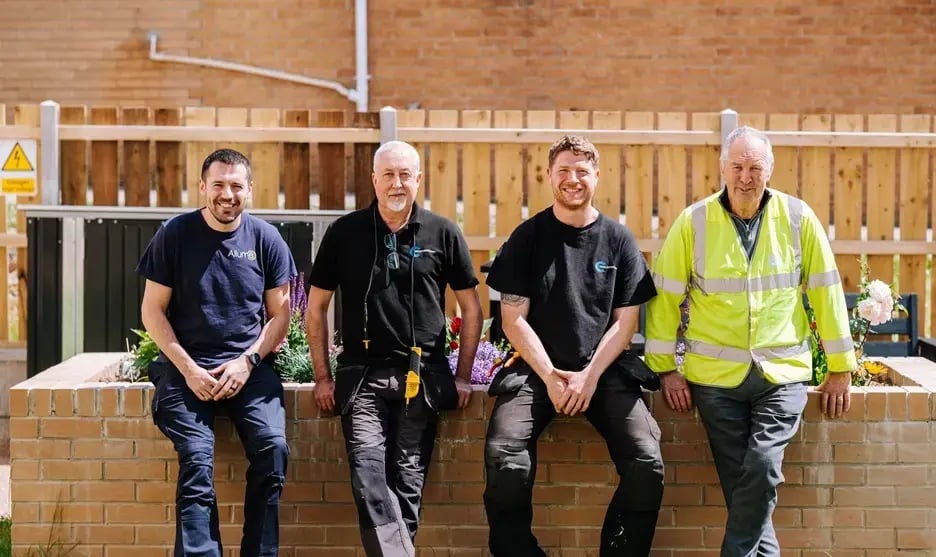
 The Allume team celebrating Scott Court being recognised as Retrofit Project of the Year (Scotland and the North) at the Unlock Net Zero Awards 2026.
Growing the UK's energy resilience requires a collective effort to eliminate fossil fuel dependence from our built environment. As summers grow warmer and winter energy prices remain deeply volatile, we cannot afford to leave flat residents and social housing tenants behind in the shade.
By shifting from individual solar logic to shared infrastructure, SolShare removes the traditional boundaries of clean energy access. Award-winning projects like Scott Court prove that we can successfully future-proof our historic urban infrastructure, eliminate fuel poverty and ensure that cheaper, cleaner energy belongs to everyone.
Are you a social housing landlord or property developer looking to future-proof your properties and reduce tenant fuel poverty? Connect with the Allume UK team today to discover how shared solar can transform your buildings.
Watch the Scott Court video: