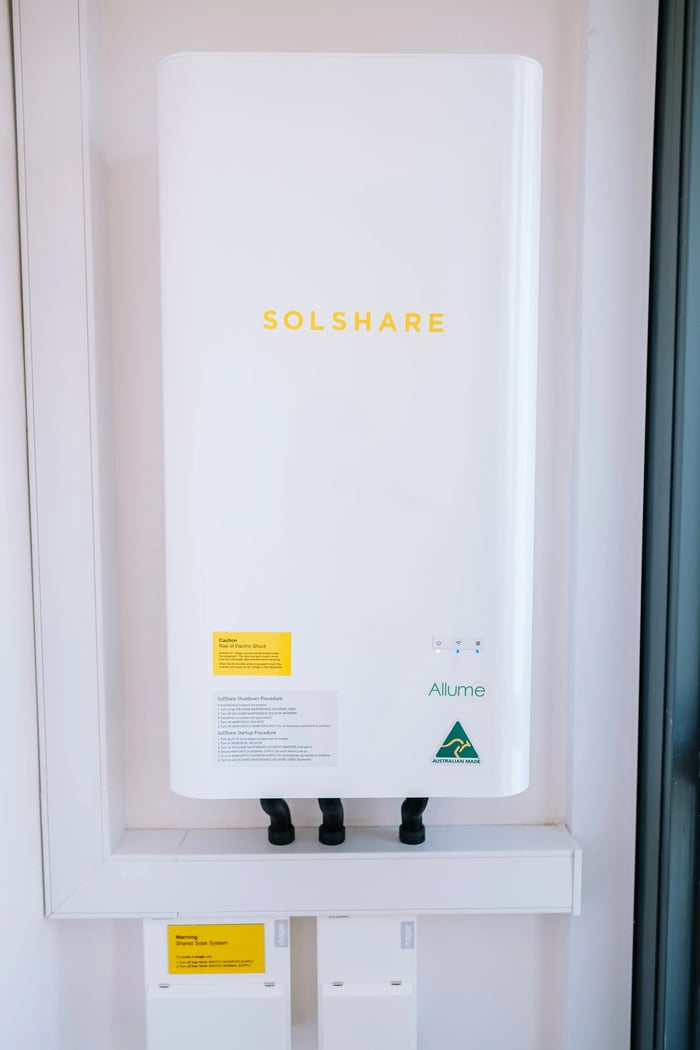

Technical deep dive: How SolShare works
This world-first technology allows a single rooftop solar array to be shared among multiple flats, delivering significant SAP score benefits, simplified wiring regulations compliance and seamless grid integration.
The SolShare algorithm hierarchy
SolShare does not simply split power blindly, it utilises a highly sophisticated, three-tier algorithm to ensure energy equity, maximise consumption, and guarantee monthly allocations.
At the point of commissioning, each flat is allocated a specific proportion of the solar PV system, measured in kWp. This allows the system to be tailored to the exact needs of every flat in the building, creating true energy equity. Typically, top and ground-floor flats suffer from worse SAP scores and EPC ratings than mid-floor flats due to exposed walls and roofs. SolShare acts as a "magic wand" for developers: a higher proportion of the solar array can be allocated to these lower-performing flats so they can "catch up" with the rest of the building. For example, a 2-bed top-floor flat might receive a 1.5 kWp allocation to jump from an EPC Band C to a B, while a 2-bed mid-floor flat only requires a 1.0 kWp allocation to achieve the same Band B rating.
Once the kWp allocation is set, SolShare continually monitors the real-time demand of every connected flat. It dynamically directs the available solar energy to the flats that actively have a load, switching delivery every 200ms. This high-speed routing maximises on-site consumption and drastically reduces solar spill into the grid, resulting in greater bill savings for every household.
Over the course of each month, SolShare meticulously tracks the exact kWh of solar delivered to each flat. If the system identifies that a flat is receiving disproportionately too much or too little energy compared to its commissioned kWp allocation, it will begin to prioritise solar delivery to the underserved flats. If the allocation cannot be perfectly satisfied within the month, any deficit is automatically rolled over into the next month so the flat can catch up.
Maximising SAP scores & EPC ratings
Because SolShare guarantees that a set proportion of solar energy will be delivered to each flat based on its kWp allocation, the system is classified under SAP 10.2 as a "PV array serving one dwelling".
Even though it is a shared system, this direct connection classification is imperative as it yields the maximum possible SAP score uplift available for solar energy. Following installation, each flat receives its own individual MCS certificate specifying its exact kWp value, which is then inputted directly into the SAP assessment.
Simplified electrical architecture
When compared to multiple, individual solar PV systems for each flat, SolShare fundamentally streamlines the building's electrical design, reclaiming valuable riser space, reducing cabling complexity, and eases fire safety concerns.
Key wiring & installation specifications:
- Single live cable: Only a single live cable is required to connect from the SolShare to each flat's solar point of connection.
- No neutral to flats: There is no neutral paired with the live cable to the flat; instead, a single neutral and earth is connected from the SolShare to the main Multi-Service Distribution Board (MSDB) or DNO cutout. Note: Because there is no neutral, Steel Wire Armoured (SWA) cable is not suitable due to eddy currents; non-ferrous cable must be used.
- CT placement: SolShare comes with 15 Current Transformers (CTs), each with 10m tails. These can be extended up to 100 metres using 24 AWG shielded and twisted pair cable, providing excellent flexibility for riser installations.
- Capacity: A single SolShare 35 unit handles a maximum input capacity of 35 amps per phase (typically paired with a 10kW to 20kW inverter) and connects up to 15 single-phase flats (or 5 three-phase flats).
Fire safety and maintenance isolation
When a multi-residential building utilises traditional individual PV systems, emergency responders are faced with multiple points of isolation scattered across the roof or building.
SolShare's safety advantage:
-
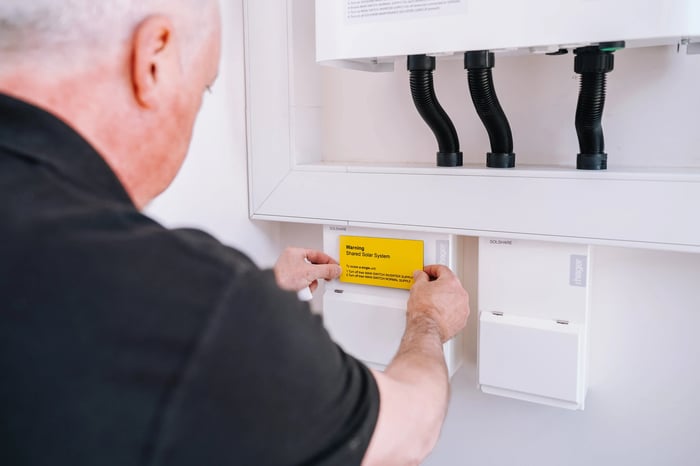
Single Point of Generation Isolation: Because SolShare centralises the PV array, only a single AC isolator is required between the inverter and the SolShare, acting as a single point of isolation for the entire solar system.
-
Dedicated Maintenance Isolation: For safe maintenance, SolShare requires dedicated isolation from each flat. A lockable consumer unit (with no bus bar) containing a single pole MCB for each flat is installed locally. The MCBs must be rated to carry the maximum current of a single phase of the inverter, as SolShare can direct all available power on one phase to a single connection.
Grid compliance and credibility
SolShare is built to the highest regulatory standards and is fully accepted for installation in the UK, offering specifiers and installers complete peace of mind.
-
Pioneering G99 Standards: Allume Energy’s technology helped author the rulebook. SolShare was used as the basis for the entirely new Section 7.8: Power Generating Module Sharing System in the ENA's Engineering Recommendation G99 Issue 2.
-
Ofgem Reviewed: The system has successfully undergone a stringent technical review by Ofgem.
-
DNO & IDNO Acceptance: Officially accepted for installation on all major DNOs and IDNO networks following a rigorous assessment by an ENA working group, which included a technical deep dive, comprehensive documentation review, and live witness tests.
-
UK CA Marked & IP56 Rated: Fully certified with the UK CA mark and IP56 rated for outdoor, unconditioned environments.
-
TrustMark: Meets TrustMark Framework Operating Requirements V2.6, most notably Section 15: Product Suitability.
-
MCS certification: Each flat receives an individual MCS certificate based on its associated kWp following commissioning.
-
10-year warranty: SolShare is supplied with a 10-year parts a labour warranty.
SolCentre reporting & battery integration
Automated reporting with SolCentre:
For housing associations and asset managers, the optional SolCentre subscription automates quarterly performance reporting. It provides full visibility of energy and decarbonisation performance across portfolios without any additional operational workload, lowering long-term OPEX.
Battery integration:
Communal DC-coupled batteries can be integrated with SolShare depending on the specific site layout. Because battery feasibility relies heavily on site variables, installers must contact Allume's engineering team during the design phase to ensure technical viability and compliance.
Technical details
Parameter |
Value |
| Dimensions | 920*485*270mm(H*W*D) |
| Weight | 38kg |
| Max Number of connections per unit | 15 single-phase or 5 three-phase(or a combination) |
| Install environment | Degree of protection IP56(as per IEC 60529) |
| Operating temperature range | -20 – 50°C |
| Metering accuracy |
+2% |
Parameter |
Value |
Max nominal current (per phase) |
35 A |
Voltage range (phase to neutral) |
216 – 260 VAC |
Voltage drop (I is nominal current) |
2.8 V |
Mains frequency range |
50–60 Hz |
Overcurrent rating |
30 KA |
Max power input at 230V (recommended) |
22 kW |
Input power factor |
1 |
Description |
Certification |
The SolShare is a certified with the Regulatory Compliance Mark (RCM) |
AS/NZS3820:2009 |
The SolShare is certified with the UK CA mark |
- |
Ready to specify SolShare?
Contact our engineering team with your project details.